 East Cooper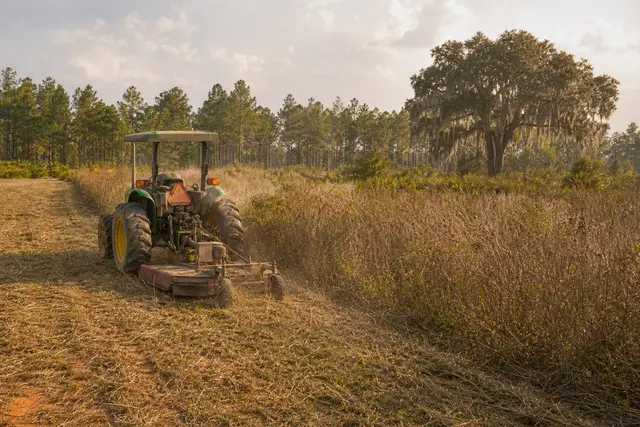

East Cooper Land Clearing pairs Mount Pleasant property owners with a local land clearing contractor for brush hogging & acreage reclamation in Mount Pleasant and the East Cooper communities around it.
Between Mount Pleasant and McClellanville, Highway 17 passes a steady inventory of land in the in-between state: former pasture going to pine, timber tracts cut years ago and never maintained, family acreage that got ahead of its owners. Brush hogging — a heavy rotary cutter run behind or beneath a machine — is the economical first pass that knocks that growth back to something walkable. The corridor is also a cultural landscape: the stretch of US 17 through Mount Pleasant was designated the Sweetgrass Basket Makers Highway in 2006, and the roadside stands where Gullah-Geechee artisans sell handwoven baskets are heritage to respect, never vegetation to clear.
What comes up on unmowed Lowcountry ground is predictable. Wax myrtle colonizes first and suckers outward, volunteer loblolly pine seeds in from every direction, and Chinese tallow finds any open, disturbed patch. Two or three growing seasons is enough to turn a mowable field into head-high brush; a few more and it is a mulching job at several times the price, which is the practical argument for cutting on a schedule rather than on a crisis.
Brush hogging suits growth up to a few inches in stem diameter; beyond that, forestry mulching takes over. An honest assessment on site sorts a parcel into the right method rather than forcing one tool onto everything. Many reclamation jobs end up as both — hogging the open ground, mulching the thickets.
East Cooper Land Clearing connects you with a contractor who cuts acreage along the corridor. The quote is free and itemized. A standing seasonal schedule is available as its own line for owners who would rather never see the brush come back.
Cutting on a rhythm, not a rescue
Fields on this coast do not hold still, so the economical strategy is rhythm: a late-winter cut before green-up that resets the field for the year, and for faster ground a second pass in late summer that catches what the first one taught to regrow. Clemson HGIC field-maintenance guidance backs the logic, since woody stems cut annually never gain the diameter that turns a mowing job into a mulching job.
Rural owners can make the schedule do double duty. SC DNR habitat programs encourage maintained openings, field borders, and food plots on private land, and a rotary cutter is the tool that creates and keeps all three. The same pass that keeps a tract walkable can be laid out to feed the deer and quail it hosts.
What hides in head-high growth
Old Lowcountry fields keep souvenirs. Downed wire from fences that rotted decades ago, hidden stump fields from a forgotten timber cut, discarded implements, and the occasional uncapped well all wait invisibly in tall growth, and any of them can wreck a rotary cutter or worse. Walking the ground before mowing it is non-negotiable on a first pass over unfamiliar acreage.
There is also a fire dividend on tracts that border pine timber. Mowed strips around field edges act as maintained fuel breaks, and the SC Forestry Commission treats exactly that kind of managed edge as a first line of defense when wildland fire moves through the coastal plain.