 East Cooper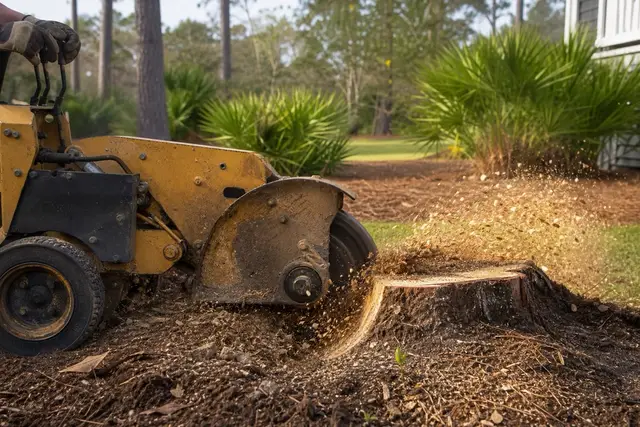

East Cooper Land Clearing pairs Mount Pleasant property owners with a local land clearing contractor for stump grinding & removal in Mount Pleasant and the East Cooper communities around it.
Stumps outlast every other trace of a removed tree. A pine taken down after a summer storm or an oak cleared for an addition leaves a root mass that will sit in the yard for a decade, sprouting suckers, dulling mower blades, and hosting the carpenter ants of greater Charleston. Grinding is the practical end of the story: a toothed wheel chips the stump into mulch, typically well below grade, until nothing remains but a shallow depression and a pile of chips.
East Cooper ground is genuinely favorable for this work. The Wando loamy fine sands that underlie most upland lots between Mount Pleasant and Awendaw are loose and stone-free, so the grinder meets wood rather than rock, and the machine tracks across dry sand without rutting a lawn the way it would in wet clay country. The same job on a saturated low spot is a different conversation, which is why timing around Charleston County's 45-plus inches of annual rain matters.
National cost guides put stump grinding at roughly $100 to $400 per stump, or about $2 to $4 per inch of diameter. The local price for any given stump turns on its size, its species, and how close a machine can get. A back-corner stump behind a fence costs more to reach than one beside the driveway, and an honest quote says so line by line.
After grinding, the chips can backfill the hole, join a mulch bed, or be hauled off. If the spot is returning to lawn, the ground can be topped with soil and seed. East Cooper Land Clearing connects you with a local contractor who counts and measures your stumps on site. The quote comes back free and itemized — per stump, with haul-off priced separately.
What happens below the sand line
Grinding in loose Wando sand goes deeper and faster than the same work in clay country, since the wheel meets no stone and the sand falls away from the cut. What remains after the machine leaves is a chip-filled crater and a web of lateral roots that stay in the ground and decay over several years. As those roots and chips break down, the spot settles, which is why a lawn repair gets topped with soil at the time of the work and again a season later.
Replanting over an old root mass is a common follow-up question, and the guidance from Clemson HGIC is practical: fresh chips tie up nitrogen as they decompose, so a new tree does better planted a few feet off the old center, in native soil rather than chip fill. ISA planting guidance covers the rest, from root flare depth to skipping the volcano of mulch against the new trunk.
Storm leftovers and pre-project stumps
Every active Charleston hurricane season leaves a delayed inventory of this work behind it. Snapped pines get bucked and hauled in the urgent weeks after a storm, and the stumps wait; windthrown oaks leave tipped root plates that have to be cut free and ground where they sit. Closing out those leftovers is often the last line item of a storm recovery, months after the tarps come off the roofs.
The other steady driver is the project that comes next. Fence builders, pool contractors, and driveway installers all price around obstacles, so grinding the stumps along a planned fence run or inside a future pool footprint before those trades mobilize keeps their quotes clean and their schedules honest.