 East Cooper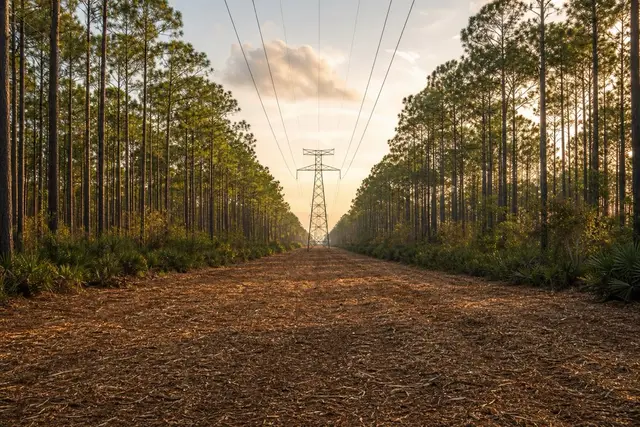
East Cooper Land Clearing pairs Mount Pleasant property owners with a local land clearing contractor for right-of-way & utility line clearing in Mount Pleasant and the East Cooper communities around it.
Every service that follows East Cooper's growth — power, water, sewer, gas, fiber — travels through a cleared corridor, and those corridors do not maintain themselves. Right-of-way clearing establishes new easements through wooded ground. It also reclaims existing ones that Lowcountry vegetation has closed back over, at the widths and clearances the utility specifies.
The buildout supplies the demand. The widening of Clements Ferry Road to four lanes and the phased development across the Cainhoy peninsula each pull new utility corridors through standing pine and myrtle, while the established easements threading Mount Pleasant, Hanahan, and the Highway 17 towns need cyclical reclearing to stay within spec. Both halves of the work run through the same equipment.
Mulching has largely displaced blading as the method of choice on these corridors, and the reasoning is soil, not fashion. A mulched right-of-way keeps its root mat and a chip layer on top of the sandy ground, which holds the corridor surface through the county's 45 inches of annual rain; a bladed corridor on the same sand becomes an erosion channel. The mulcher also works selectively, taking the corridor down without disturbing what stands beyond the stakes.
Regrowth here is fast enough to make maintenance cycles a planning fact rather than an afterthought. Wax myrtle reaches 15 to 20 feet and recolonizes from suckers, so a corridor cleared once is a corridor scheduled. Honest right-of-way pricing reflects the return interval rather than hiding it.
East Cooper Land Clearing connects utilities, contractors, and easement holders with an operator who prices by corridor mile and width. The quote is free and itemized. The initial cut and the maintenance cycle are priced separately, so each stands on its own.
Cycle length on a coast that never stops growing
Corridor maintenance intervals are set by biology, and coastal biology is quick. The Charleston area's long frost-free season gives myrtle, tallow, and vine most of the year to work, so a corridor cleared to spec regrows toward the conductors faster here than the same corridor would inland. Clemson HGIC growth-rate information for these species is the sober planning input: cycles get set by measured regrowth, and coastal cycles run short.
The management answer is segmentation. Corridors mapped in segments, each with its own last-cleared date and its own return interval, turn re-clearing from an emergency into a rotation, and the easement holder can budget years ahead instead of reacting to the segment that got away.
Corridors as storm infrastructure
When a tropical system crosses the Lowcountry, the outage map is largely a vegetation map: most line damage comes from trees and limbs that were within falling distance when the wind arrived. That is what makes corridor clearance storm infrastructure rather than groundskeeping. The weeks before the season that NWS Charleston tracks from June through November are when clearance work pays best, taking danger trees and encroaching regrowth out of range while the weather is quiet. SC Forestry Commission: vegetation, fuels, and corridor fire safety provides an independent benchmark for this right-of-way & utility line clearing decision.