 East Cooper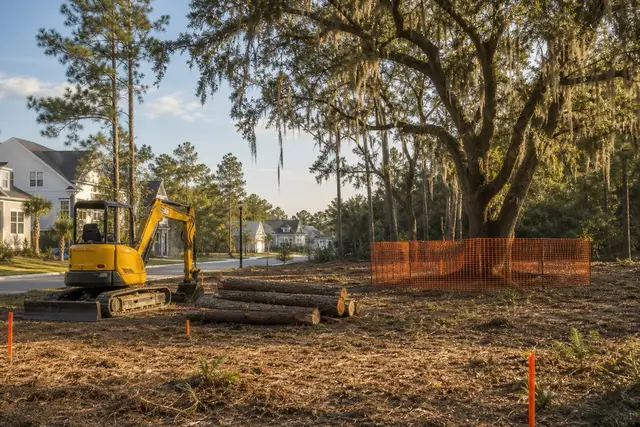

East Cooper Land Clearing pairs Mount Pleasant property owners with a local land clearing contractor for lot clearing for new builds in Mount Pleasant and the East Cooper communities around it.
Mount Pleasant counted 90,801 residents at the 2020 census, up 33.8 percent in a decade. That makes it South Carolina's fourth-largest municipality, and every one of those new rooftops began as a wooded or overgrown lot. Lot clearing here is structural demand, not a passing wave, and it comes with rules that predate whatever house you are planning.
The rule that shapes everything is the town's tree ordinance. Residential trees measuring 16 inches DBH or larger — diameter taken at 4.5 feet up the trunk — are protected, with pines protected from 24 inches, and removal requires a tree-removal or clearing-and-grading permit from the Zoning Administrator before any saw starts. A lot plan drawn without a tree survey is a lot plan that will be redrawn.
Historic trees, those 24 inches DBH and larger, carry a further step: the removal request must be accompanied by an arborist report. On older Mount Pleasant lots shaded by live oaks that predate the subdivision, this is often the pivotal document. The practical path is usually to design the clearing around the historic canopy rather than through it.
Once the permit picture is settled, the physical work is straightforward on East Cooper ground. Unprotected trees come down, understory is mulched or hauled, and stumps are ground out. The sandy Wando soil is left ready for the grading contractor. What separates a clean job from a costly one is sequencing the paperwork before the equipment.
Send East Cooper Land Clearing your parcel details and build timeline. A land clearing contractor familiar with the town's permitting sequence will return a free, itemized quote. Clearing, stump work, and haul-off each appear as separate line items.
The tree survey comes first
On a wooded Mount Pleasant lot, the first professional on site should be holding a diameter tape, not a chainsaw. A tree survey locates and measures every trunk at or above the town's protection thresholds, and the clearing plan is drawn around what that survey finds. For the oldest specimens, the ones measuring 24 inches and up, the removal request needs a supporting report, typically prepared by an ISA arborist after a proper hazard and health assessment. Skipping this sequence is how lots end up with stop-work orders and redrawn site plans.
The trees that stay need defending while the ones that go come down. Temporary fencing at the driplines of keeper oaks, no fill or chip piles inside those circles, and equipment routes planned away from root zones are the difference between a live oak that shades the finished house and one that declines over the five years after move-in.
From standing pine to builder-ready ground
Once the permit picture is settled, a full-scope clearing runs through a predictable sequence:
- Felling and hauling the unprotected timber, with merchantable pine sometimes offsetting cost on larger lots
- Grubbing stumps and roots inside the building footprint
- Mulching understory across the rest of the parcel
- Root raking and rough shaping so the grading contractor inherits clean sand
Demand context matters for scheduling. Census QuickFacts shows Mount Pleasant adding roughly a third to its population in a single decade, and builders in that kind of market book months ahead. A lot that is surveyed, permitted, and cleared moves to the front of a builder's queue; one still wearing its woods waits at the back.