 East Cooper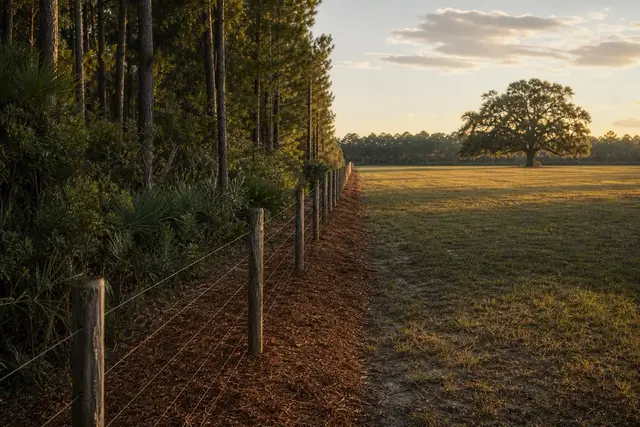
East Cooper Land Clearing pairs Mount Pleasant property owners with a local land clearing contractor for fence line & property line clearing in Mount Pleasant and the East Cooper communities around it.
Fence lines disappear quickly in the Lowcountry. Wax myrtle suckers along the wire, smilax and muscadine vine lace through the pickets, and within a few unattended seasons the boundary of a property is a green wall nobody can see through, let alone repair. Clearing the line means removing that growth on and beside the fence so the fence itself — or the surveyed line where a new one will stand — is visible and workable again.
The shape of the job varies across the service area. In built-out Berkeley County suburbs like Hanahan, it is narrow-access work between houses, done with compact equipment and hand cutting where a machine will not fit. Out on Awendaw and Huger acreage, it can mean long runs of pasture wire or timber-tract boundary swallowed by a decade of myrtle and pine volunteers, cleared as a mulched corridor wide enough to walk and maintain.
Boundaries deserve care that open ground does not. Work stays on the client's side of the surveyed line unless the neighbor has agreed otherwise, and corner pins and survey stakes are located before cutting rather than after. Any large oak or pine standing on the line is left alone — in Mount Pleasant, trees at 16 inches DBH and pines at 24 are protected by ordinance wherever on the lot they stand.
A cleared line is also the honest prerequisite for a fence quote, since fencing contractors price visible, accessible runs very differently from overgrown ones. East Cooper Land Clearing connects you with a local clearing contractor who walks the line with you and measures the actual footage. The quote comes back free and itemized, by the run rather than a guess by the acre.
Pins, plats, and where the line really runs
Old Lowcountry fences are unreliable narrators. Wire strung generations ago often wanders off the true boundary, and clearing along the fence is not the same thing as clearing along the line. Before cutting, the recorded plat gets pulled, and Charleston County keeps parcel records and GIS mapping that show where the surveyed corners should be. Then the pins themselves get found with a metal detector and flagged.
When pins are missing, which is common on rural tracts that have not been surveyed in decades, the honest sequence is surveyor first, saw second. Cutting a corridor on a guessed line creates exactly the neighbor dispute the clearing was supposed to prevent.
Why the green wall returns and how to slow it
A fence line is the perfect nursery: birds perch on the wire and plant seed beneath it, and the plants that thrive there are the stubborn ones. Smilax regrows from underground tubers the size of potatoes, muscadine sends runners yards in a season, and myrtle suckers outward from every cut stem. Clemson HGIC documents why these species shrug off a single cutting, which is worth understanding before expecting one pass to be permanent.
The durable answer is a corridor wide enough to maintain with ordinary equipment, mowed or touched up annually so nothing gets ahead again. On big rural boundaries there is a bonus: SC DNR habitat guidance notes that maintained edge corridors are heavily used by deer and turkey, so a clean line doubles as the best game trail on the property.