 East Cooper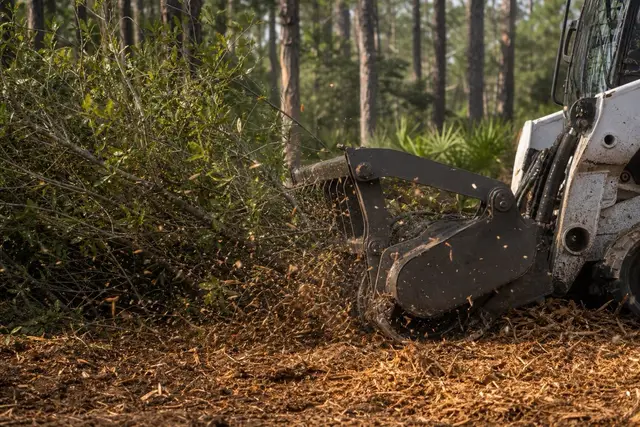

East Cooper Land Clearing pairs Mount Pleasant property owners with a local land clearing contractor for forestry mulching in Mount Pleasant and the East Cooper communities around it.
Forestry mulching has become the default clearing method in the Charleston Lowcountry for a simple reason: the vegetation here suits it. A mulching head on a tracked machine works through palmetto understory, wax myrtle thickets, and small loblolly pine in a single pass, grinding everything into chips that stay on the ground. There is no pile to burn, no debris to haul up Highway 17, and no torn-open soil waiting for the next storm.
The burn question matters more in South Carolina than most homeowners expect. State law requires notifying the SC Forestry Commission before any outdoor debris burn outside town limits, along with a firebreak, suppression equipment on hand, and attendance until the fire is out — and the Commission issues periodic statewide burn bans on top of that. Mulching sidesteps the entire framework: nothing is burned, so there is no notification call to make and no ban window to wait out.
The mulch layer itself does quiet work after the machine leaves. Charleston County averages 45.30 inches of rain a year, and the sandy Wando soils that underlie most upland East Cooper lots erode readily once stripped bare. A few inches of ground hardwood and pine holds that sand in place, suppresses the first flush of regrowth, and breaks down into the soil rather than leaving a scar.
Local pricing runs meaningfully higher than the national teaser rates that circulate online. South Carolina contractor guides put mulching at roughly $300 to $500 per acre for light brush and $500 to $800 for medium growth. Dense tallow, palmetto, or wet ground pushes the figure to $800 to $1,400 or more. Minimum job fees in the Charleston tri-county area typically land in the $1,200 to $1,500 range, driven by access and ground conditions rather than padding.
East Cooper Land Clearing passes your acreage, vegetation type, and access details to a land clearing contractor working the Mount Pleasant area. The contractor walks the parcel before quoting anything. The quote comes back free and itemized, with no obligation attached.
Wando sand and the 45-inch rain year
Charleston weather does not deliver its rain gently. NWS Charleston climate records show much of the annual total arriving in short, violent summer bursts, and a tropical system can drop several inches on East Cooper ground in a single afternoon. Stripped Wando sand has no answer for that kind of water: the fine grains lift and travel with the first hard sheet flow, carrying seed bed and topsoil toward the nearest ditch. A ground layer of fresh chips changes the physics, breaking raindrop impact and slowing runoff enough for the loose sand beneath to drink it in.
The chip blanket keeps paying after the storm passes. Sandy coastal soils are famously hungry for organic matter, and a few inches of ground pine and hardwood act as a slow-release amendment, feeding soil fungi and holding moisture through the long August dry spells between thunderstorms. By the second growing season the lowest layer is already turning to something closer to topsoil than debris.
Grand trees and the town's rulebook
Mount Pleasant treats its biggest trees as civic property in all but title. The Town of Mount Pleasant protects residential hardwoods from 16 inches in diameter and pines from 24, and the oldest live oaks carry an extra layer of process before anyone may touch them. Mulching fits neatly inside that framework because it removes only the small-diameter understory. The protected canopy stays exactly where the ordinance wants it, and most understory-only projects never need a permit conversation at all.
The care that matters is below ground. A mature live oak sends roots far past its dripline, and ISA consumer guidance is blunt about how much harm compaction and root cutting can do to an old tree. On a well-run job the machine stays off the root flare, chips are spread thin rather than mounded against trunks, and hand tools finish the tight ground beneath the biggest oaks.